Image by FIFA
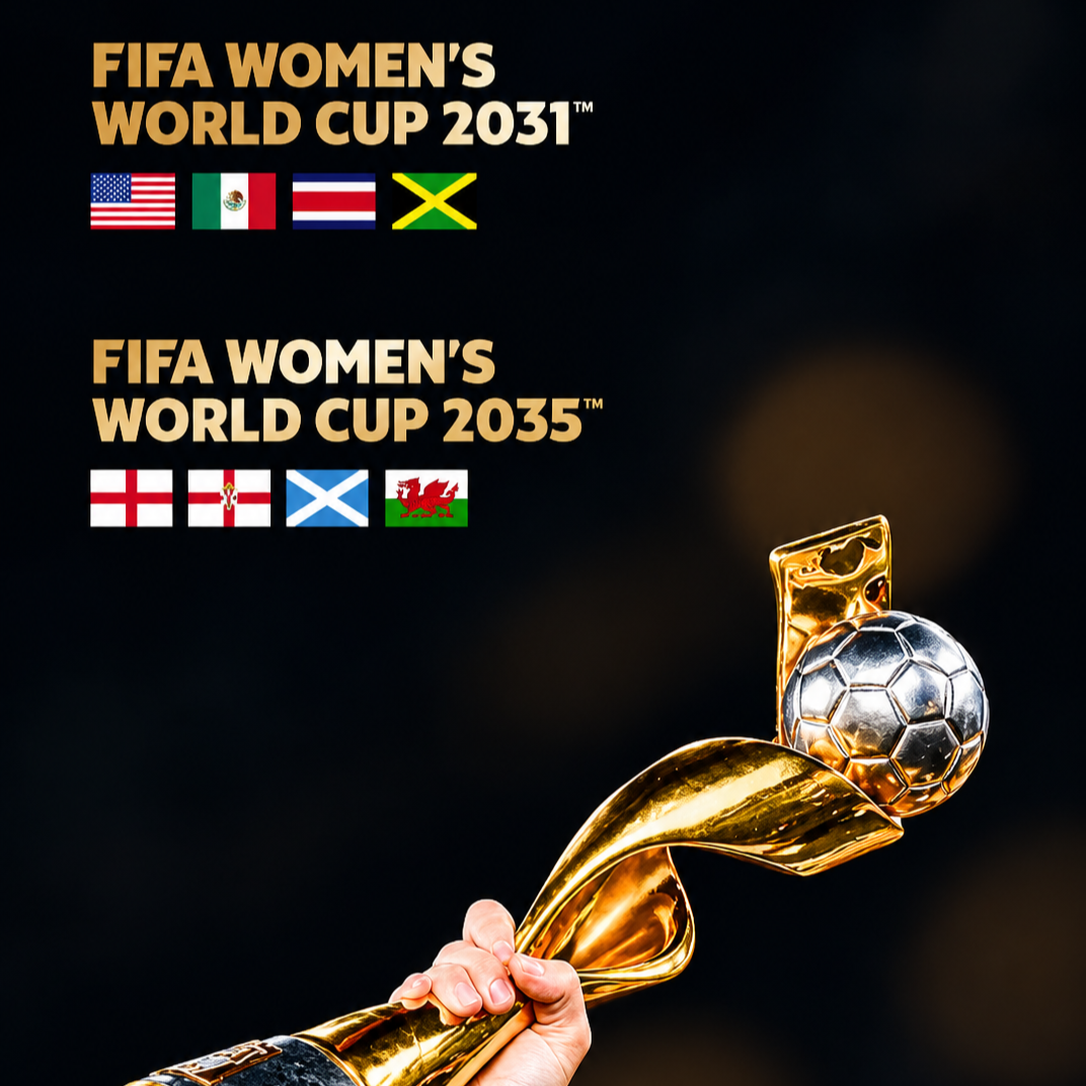
FIFA's Member Associations on Monday appointed the United States, Mexico, Costa Rica and Jamaica as hosts of the 2031 FIFA Women's World Cup, the first edition with 48 teams, and confirmed England, Northern Ireland, Scotland and Wales as hosts in 2035. Both decisions were taken by acclamation at a virtual Extraordinary Congress.
They put the first two expanded tournaments in two of the most commercially developed markets in women's football.
Neither bid had a rival
The FIFA Council launched both bidding processes in March 2025, and the appointments were originally due at the 76th FIFA Congress in Vancouver on 30 April 2026. FIFA's evaluation reports, published earlier this month, found that both bids met the minimum hosting requirements.
The 2031 bid proposes 20 stadiums: 14 in the United States, four in Mexico and one each in Costa Rica and Jamaica. Organisers expect 4.5 million fans. Under the expanded format there will be 12 groups of four, 104 matches instead of 64, and a tournament one week longer. The United States last hosted in 2003, after 1999. The UK nations have never hosted the senior women's tournament.
FIFA President Gianni Infantino said ahead of the vote: "Our objective, of course, is making women's football truly global, and (to) build the future together with all Member Associations and with all stakeholders. Today, we decide here on the hosts of the FIFA Women's World Cup 2031 and 2035. This is a proud moment for you, this is a proud moment for us, for all of us."
He added: "But 2031 and 2035 should reach far beyond the pitch. More women player(s), more girls inspired, more women coaches, more women referees, more women administrators, more women leaders. Our priorities for the women's game are very, very simple: we have to expand the game globally, we have to close the gaps that still, of course, exist and we have to build the future together."
In his closing remarks, Infantino said: "Football belongs to everyone, everywhere in the world, and we have to create opportunities, we have to create development, we have to create infrastructures. We need resources, as well, to be able to make this happen. And together, we will have a real impact."
2035: was open to both UEFA and CAF
The 2035 race was open to members of both UEFA and CAF, so Africa had a route in. In March 2025 Spain's football federation announced a joint bid with Morocco and Portugal, the three co-hosts of the 2030 men's World Cup. The bid was withdrawn within days after Morocco stepped back, according to Portuguese news agency Lusa, and the three federations have since said they are looking at 2039. No African country has hosted the senior Women's World Cup. South Africa pulled its bid for 2027 in November 2023.
Change for African Football
The bigger change for African football is the size of the field. From 2031, CAF has seven direct places plus two of the 12 places in the inter-confederation play-off for the last three spots. In 2023, CAF had four direct places, taken by Morocco, Nigeria, South Africa and Zambia. With up to nine African teams able to qualify, more federations will collect FIFA participation money, and more national teams will have World Cup exposure to sell to sponsors. FIFA put $110 million into prize money for the 2023 tournament. The 2031 payout has not been announced, but a 48-team event will need a bigger pool.
Qualifying costs will rise too. Many CAF women's programmes still rely heavily on FIFA development funding to cover camps, travel and staff. A bigger qualification slate puts more pressure on federation budgets well before any prize money arrives. Infantino's "we need resources" comment applies at least as much to those federations as to the hosts.
Time zones will shape the commercial return
A 7pm kick-off on the US east coast is midnight in Lagos and 2am in Nairobi. That makes 2031 a hard sell for African broadcasters and the brands buying around them. The 2035 tournament in the UK will be played in British Summer Time, the same clock as Lagos and an hour or two behind Johannesburg and Nairobi. For African media buyers, 2035 is the edition to plan for.
Morocco is the African country best placed for the tournament after that. It is hosting the FIFA U-17 Women's World Cup every year from 2025 to 2029 and co-hosting the 2030 men's World Cup. By the time the 2039 bidding process opens, it will have organising experience few federations can match.