AFCON 2027 hosts must plan for stadium use beyond the tournament, ACG chief says
Paulo J. Cruz, Founding CEO of African Collaborations Group (ACG) | Image by ACG
East Africa’s AFCON 2027 co-hosts are spending heavily to get stadiums ready for CAF inspection. The bigger commercial question is what those venues will earn once the tournament leaves. Paulo J. Cruz, Founding CEO of African Collaborations Group (ACG), told Business of Sports Africa that hosts should answer it now, while construction is still under way.
“They should stop planning for the tournament and start planning for the 30 years after the tournament,” Cruz said in written responses to BOSA. “Every major tournament is a four-week event. The infrastructure must justify itself for decades.”
The cost of getting ready
In Uganda, the second phase of the Mandela National Stadium (Namboole) remodel is expected to cost the government USh248 billion (approximately US$59.5 million). The first phase cost USh97 billion (US$23.3 million), the Daily Monitor reported in February, and the work is being carried out by the UPDF Engineering Brigade under the Ministry of Defence and Veteran Affairs. Cruz put Uganda’s public spend at approximately US$69 million. In Nairobi, the 60,000-seat Talanta Stadium was 94% complete when MPs inspected it in early October. Its estimated cost has risen to KSh45.8 billion ($352.7 million ) from an initial KSh35 billion ($269.5 million ), Capital FM reported.
What happens to Namboole after the final?
Cruz used Namboole as his example, “The entire national conversation is about construction deadlines and CAF inspections. But the day after AFCON ends, the conversation will shift overnight to: what do we do with Namboole now? If the answer has not been planned in advance, Uganda will have created another white elephant.” “What should be planned now, while renovation is underway, is the ecosystem around the stadium,” he said. “What commercial, hospitality, entertainment, and training infrastructure can be developed on and around the site to create year-round activity? What PPP structures can bring private capital into a post-AFCON development without additional public spending?”
Cameroon’s AFCON stadiums are still unfinished four years on
The last AFCON cycle shows why the question matters, Cameroon’s Olembé and Japoma stadiums, built for the 2021 Africa Cup of Nations held in early 2022, took more than 400 billion CFA francs (more than US$ 680 million) between them. According to Cameroonian outlet Camer.be, neither was fully finished as of May this year.
Cruz blamed how venues are planned rather than a lack of demand. “The failures are consistent across the continent, and they are all design failures, not market failures,” he said. He cited reliance on matchday income, no commercial activity around the venue, no professional operator, no year-round events calendar and no maintenance funding.
ACG sets out its district model as talks with governments continue
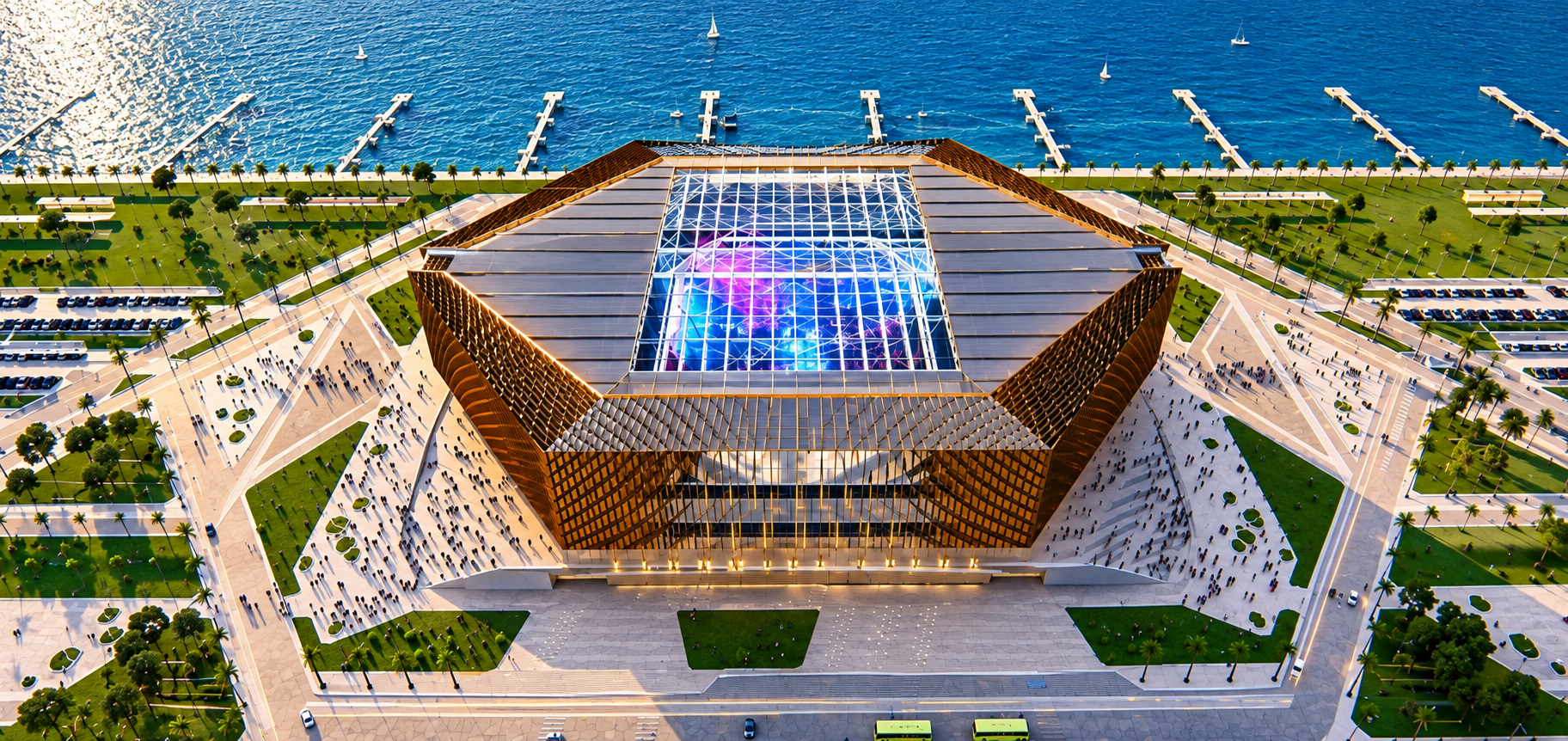
ACG’s answer is what it calls Victory District™: mixed-use precincts that put stadiums alongside hotels, retail, offices, housing, schools and training academies. These are financed as project finance through private and institutional capital. Under that structure, Cruz said, the host government provides the site, a PPP concession and regulatory support. “It does not borrow. It does not guarantee the debt. The government’s budget is not touched.”
The company has not yet named a project. Asked which markets it is prioritising, Cruz said: “I will not name specific countries publicly at this stage, as these engagements are confidential.” He said ACG’s most advanced project covers 236 hectares, and that it is in discussions with governments that have expressed formal interest. ACG’s advisory board includes former FIFA Secretary General Fatma Samoura and former World Bank Executive Director Paulo Gomes.
Cruz says investors underestimate African demand
On investor appetite, Cruz argued that demand is the most misread risk. He pointed to the World Bank’s October upgrade of its 2026 growth forecast for Sub-Saharan Africa to 4.3%. He also cited UN Tourism data showing international arrivals to Africa rose 4% in the first half of 2026, against 0.4% globally. He added that investors “overestimate political risk in markets where PPP frameworks are well established and where governments are actively seeking private capital for infrastructure.” He said the same applies to Morocco ahead of the 2030 World Cup. “The tournament should be the launchpad, not the purpose.”
The window for private capital opens once the tournament ends
Few would argue with planning around the stadium. However, the harder problem is timing. Namboole and Talanta are being built with public money on public contracts, to CAF’s deadlines. A district model needs land around the venue, a concession framework, an operator, and lenders willing to finance hotels, offices and retail on the strength of a stadium’s events calendar. Little of that can be in place before the tournament. Realistically, the window is the post-AFCON phase, which is Cruz’s point about Namboole. Whether private capital follows is still an open question. ACG’s model depends on large, multi-asset developments, and the next milestone will be naming a host government and a financing partner. For Uganda, Kenya and Tanzania, there is a nearer test: whether each venue has an operator, an events calendar and a maintenance budget agreed before the tournament ends.
This interview was facilitated by APO Group, which was founded by ACG founder Nicolas Pompigne-Mognard.
Recommended for you